

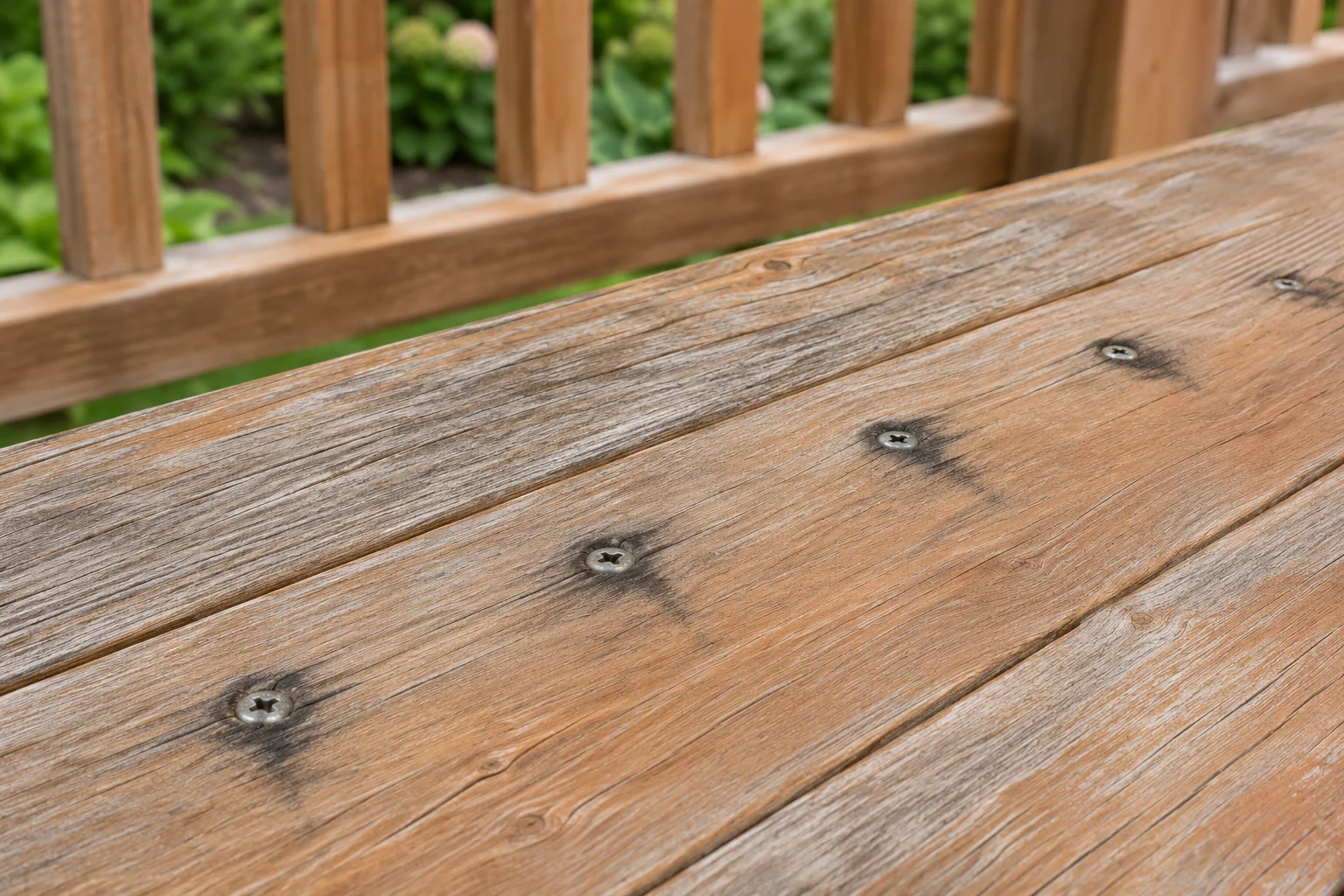
Small black rings around deck screws can stand out against cedar’s warm grain. Sometimes they appear as short streaks. In other places, several marks form a dark line across the boards.
For homeowners considering cedar deck repair in Cutchogue, NY, the first step is to find out what those marks mean. Surface discoloration, corroded fasteners, and damaged wood can call for different work. Cleaning the marks without checking their source may leave the underlying problem in place.
Golden Hands Deck provides deck services in Cutchogue, including cedar decking and repairs. A useful assessment separates appearance concerns from fastening and board condition before recommending treatment.
Why black marks can form around cedar deck screws
Metal fasteners are one possible source of staining on cedar. The Western Red Cedar Lumber Association explains that unsuitable nails can corrode and react with cedar’s natural compounds, leaving stains and streaks. Its cedar decking fastener guidance recommends stainless steel screws and distinguishes between grades for different exposure conditions. Real Cedar
That does not mean every black mark proves the wrong screw was used. Dirt, surface growth, old coatings, and other sources of discoloration can complicate the picture.
The pattern offers clues. Marks centered on many screw heads deserve a closer look at the fasteners. Broad dark patches away from them may need a different investigation. Both patterns can also occur on the same deck.
Avoid choosing a treatment based only on color. The contractor needs to consider the wood, the hardware, the existing finish, and the condition of the affected area.
A stain is not a complete safety assessment
A dark ring does not tell you whether a screw still holds properly. It also cannot show the condition of the wood beneath a board or the framing below it.
Likewise, a screw head that looks clean does not prove that the whole connection is sound.
Tell the contractor if you have noticed raised fasteners, a shifting board, cracks near fixing points, or movement at the railing. These observations can change the scope from surface care to repair.
If a board moves, a stair feels unstable, or a railing is loose, keep people away from that area until it has been assessed. Do not lean on a questionable railing or repeatedly step on a suspect board to test it.
Photos help explain the concern when arranging a visit. They cannot confirm structural safety or replace an on-site assessment.
What a cedar deck repair assessment in Cutchogue should cover
Start with the history you know. Share when the deck was built, whether boards have been replaced, and when the marks first appeared. Old invoices or leftover fastener packaging may help identify materials.
Explain whether the staining is limited to one repaired section or spread across the deck. A patch with different screws or a newer finish may need separate attention from the original boards.
The contractor should consider whether the visible marks are mainly cosmetic, whether the fasteners need further examination, and whether the surrounding wood can support a lasting repair.
Access matters too. Let the company know if the underside is enclosed, if a section is elevated, or if furniture blocks the affected boards. Do not remove boards or crawl into an unsafe space before the visit.
For a Cutchogue property that is used seasonally, arrange access while someone can discuss the findings and approve the written scope.
Why an ordinary deck wash may leave the marks behind
General dirt and metal-related discoloration are different cleaning problems. A product that removes grime may have little effect on a stain associated with a fastener.
The Western Red Cedar Lumber Association’s deck care guidance notes that cleaners vary in their ability to remove iron stains, tannin stains, and weathered gray wood. It also warns that power washers can seriously damage cedar surfaces and does not recommend them for cedar. Real Cedar
A stronger wash is therefore not a reliable answer to a stubborn black ring. It may alter the surrounding surface while leaving the original mark visible.
A suitable treatment needs to account for the stain and any existing coating. Before broader work begins, discuss a test area, the expected result, and whether some discoloration may remain.
Do not mix cleaning chemicals or use a household stain-removal recipe without checking compatibility with the decking and finish.
When fastener work belongs in the repair plan
If fasteners are contributing to the staining, treating the wood alone may not resolve the cause. The contractor may recommend addressing affected hardware as part of the work.
Replacement is more involved than choosing a screw with a similar-looking head. The fastener must suit its purpose, the wood and supporting materials, and the site’s exposure.
For properties exposed to salt air, the cedar association recommends a different stainless steel grade from the one it describes as adequate for most applications. That makes actual exposure relevant; the town name alone does not determine the correct hardware. Real Cedar
Ask the contractor to explain the proposed fastener specification and why it suits your deck. Avoid removing rows of screws yourself or replacing structural connectors with general deck screws.
The repair plan should also address wood around the fixing points. New hardware cannot compensate for wood that no longer provides a suitable connection.
When a stained board may need replacement
Appearance alone should not decide whether a board stays or goes.
A board with surface staining may remain usable after an appropriate assessment. A board with significant splitting, decay, or damage around its fixing points may require a different approach.
If replacement is proposed, ask why treatment or a smaller repair would not meet the goal. Also ask how the new board will compare with the existing deck.
New cedar may differ in color and grain from older boards. A repair can be sound and still remain visible. An exact visual match should not be promised before material selection and finishing options are reviewed.
Golden Hands Deck’s cedar decking service provides a starting point for discussing material choices when replacement boards are needed.
What should affect your written estimate
The number of stained screws is only part of the job. Access, fastener condition, board damage, and the existing coating can all affect the work.
A useful written estimate should distinguish stain treatment from hardware work and board replacement. It should explain which sections are included and what would happen if further damage becomes visible during the agreed work.
Ask whether the price includes surface preparation and any later finishing. Treating isolated marks may produce a different appearance from preparing a larger, consistent area.
Discuss expectations before work starts. Are you trying to reduce visible rings, correct unsuitable hardware, replace damaged boards, or combine those tasks?
Clear answers make quotes easier to compare and reduce the chance of paying for a cosmetic treatment when repair is the real priority.
Plan the repair before covering the marks
Painting or staining over dark rings may change their appearance, but it does not identify their cause. Deal with any fastening or board concerns before choosing a new finish.
Keep photos and the final written scope with your property records. Record the materials used in the repair so a future contractor has a clearer starting point.
For cedar deck repair in Cutchogue, NY, request a free written estimate from Golden Hands Deck or call 631-655-5616. Share photos of the marks and mention any loose boards, raised fasteners, or recent repairs so the visit can focus on the work your deck needs.
Share
Related Posts
November 14, 2026
Deck Stair Tread Repair in Laurel, NY
A split board on a deck step may look like a small repair. But replacing…
November 11, 2026
Deck Replacement in East Quogue, NY, With Narrow Yard Access
A narrow gate does not automatically rule out replacing your backyard deck. But it can…
November 4, 2026
Deck Board Replacement in Mattituck, NY: Can You Keep Your Existing Deck Frame?
Deck board replacement in Mattituck, NY, can give an aging outdoor space a fresh appearance…


