

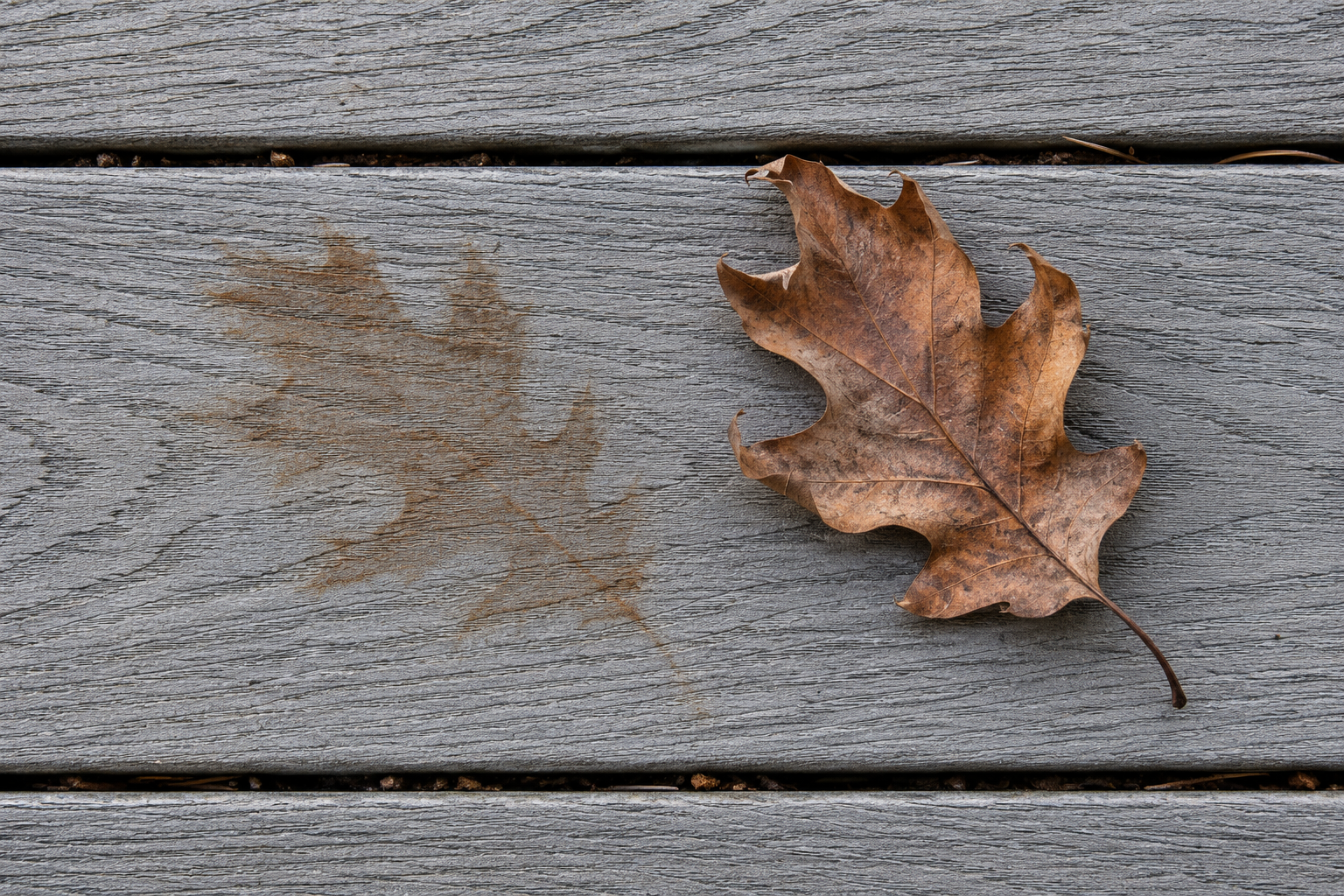
You sweep a pile of wet leaves off the deck and find that one leaf seems to have stayed behind. Its outline is still there, right down to the pointed edges. If you’re cleaning leaf stains on a composite deck in East Marion, start by clearing the loose debris and letting the boards dry. Then check the care guide for your decking before choosing a cleaner. A brown leaf print can need a different treatment from the dirt around it. Trex
What a leaf print can tell you
Look at where the mark begins and ends. A cluster of brown outlines in the exact spot where leaves collected gives you a good reason to suspect tannins, natural compounds that can leave color behind. An even brown film along the path from the yard to the back door gives you a different starting point. Clean off the tracked-in dirt first and see what remains when the deck dries. Trex
Pay attention to the shape, too. A sharp circle that lines up with a planter deserves a closer look before you treat it as a leaf stain. Lift the pot if you can move it easily. Is there loose soil underneath? Is the circle pale or brown? Does the same mark appear under a second pot? Those observations will help you describe the problem if an ordinary wash leaves it behind.
Find out which boards you have before you wash them
If you still have the installation invoice, look for the collection name. A spare board with its original label is useful, too. “Gray composite” tells you the color and general material, but it gives you little guidance about which cleaning products the surface can tolerate.
This matters even within one brand. Trex publishes separate care instructions for newer decking lines and early-generation boards. Its guide also distinguishes everyday dirt, tannins from debris, and mineral spots left by hard water. If your deck is Trex, look up your collection and the type of mark you see in the Trex deck care and cleaning guide. Trex
If you inherited the deck with the house, an old invoice may be hard to find. Check whether a previous owner left a product booklet or a labeled offcut in the garage. If the brand remains uncertain, leave stain removers and pressure washing until someone can assess the boards. A small brown print is easier to live with than a pale patch in the middle of the deck.
Start with one board and let it dry
Choose an affected board where you can see both the mark and a stretch of ordinary deck surface. Take a photo while the board is dry. Clear the leaves with a broom or garden hose. For Trex collections whose instructions call for warm soapy water and a soft-bristle brush, use that method to lift dirt from the grain, then rinse the area thoroughly. Follow the instructions for your own collection if they differ. Trex
Give the board time to dry before judging the result. Compare it with the photo from the same angle. If the dirt has lifted and the leaf outline has gone with it, you have a practical method for the rest of the affected area. If the grain looks clean but the outline remains, you have learned something equally useful. Repeating the same pass with a stiffer brush makes little sense when you have already removed the dirt.
What to do when the brown outline remains
Turn to the manufacturer’s instructions for tannins. Trex names a deck brightener for tannins from debris on certain collections and directs owners to follow the brightener manufacturer’s directions. Check both the decking guide and the product label before buying. The word brightener on a bottle alone does not establish that it suits your boards. Trex
Also check whether every stained board belongs to the same installation. Perhaps the boards by the steps were replaced while the original ones stayed near the house. If the line between the two areas is visible, take a photo that includes it. Tell the person cleaning the deck which boards were replaced, if you know. A successful test on a newer board tells you little about how the older section will respond.
When to book deck cleaning in East Marion
One leaf print beside a chair is a reasonable place to try an approved cleaning method yourself. A full season’s buildup across the floor, steps, and edges is a different-sized job. Professional cleaning is worth considering when you cannot identify the decking, a mark survives the recommended treatment, or much of the affected surface sits beneath heavy furniture.
When comparing estimates, describe the area you want cleaned. “The landing and four steps have leaf marks” is more useful than the square footage of the whole deck. If you also want the space beneath a dining set cleaned, ask who will move it. And if a remaining stain may need a second treatment, ask whether that work is included in the written price. These details make it easier to compare two quotes for the same job. Golden Hands Deck outlines its service on the deck power washing page. goldenhandsdeck.com
Keep the same patch from staining again
The next time leaves blow across the deck, notice where they stop. The open floor may clear easily while a handful stays wedged behind the storage box or under the bench. Sweep that pocket when you clear the walking area. If moving a planter a few inches gives you room to reach behind it, that small change may be enough. Trex’s guidance on tannins starts with removing the debris that collects on the surface. Trex
If leaf marks remain on your East Marion deck, tell Golden Hands Deck where they appeared, what you’ve tried, and whether you know the board brand. For a free written deck cleaning estimate, contact Golden Hands Deck or call (631) 655-5616.
Share
Related Posts
November 12, 2026
Composite Deck Winter Care in Hampton Bays, NY
A composite deck may need less routine upkeep than a wood deck, but winter still…


