

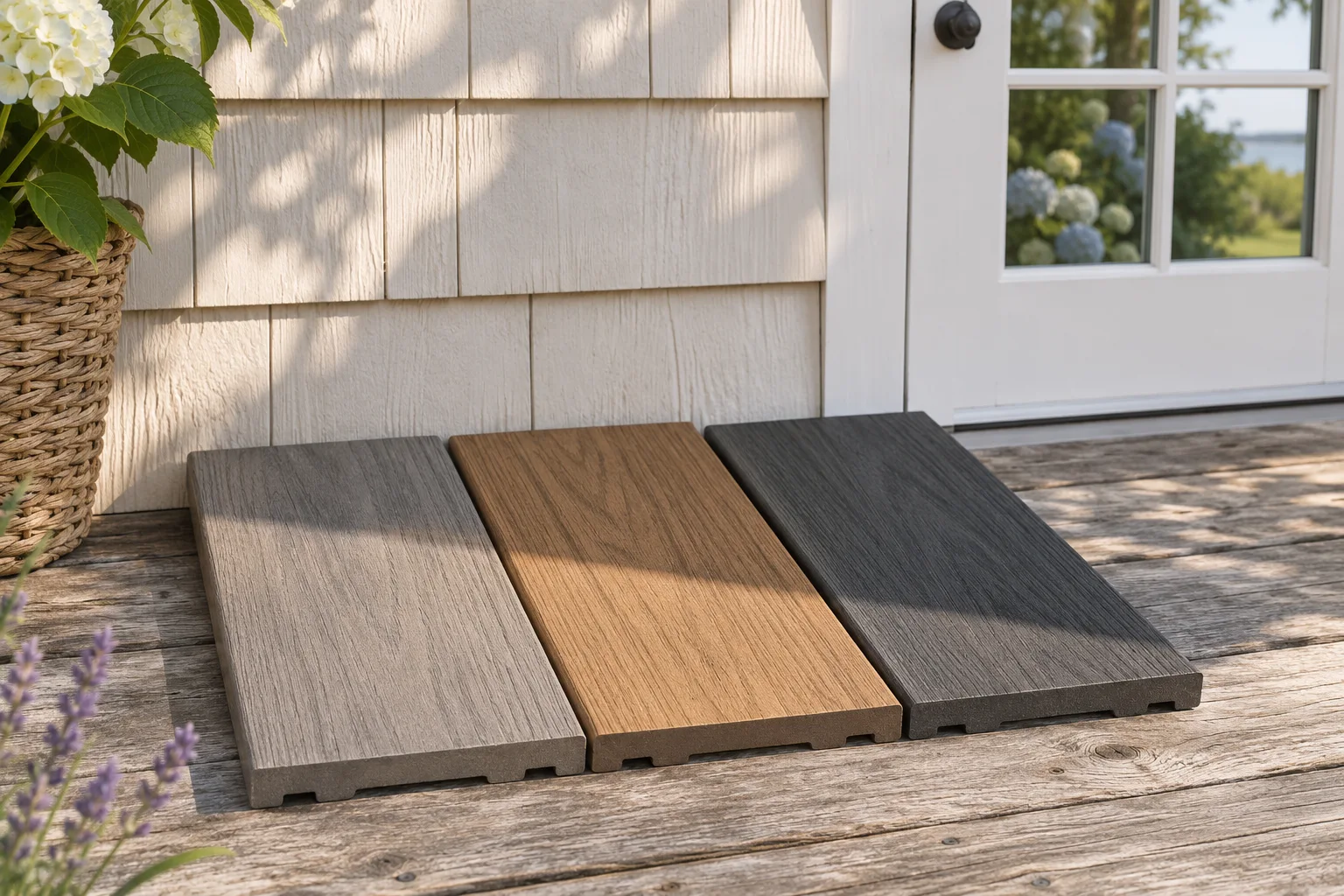
A driftwood-gray deck board can look perfect in a showroom. Set it beside your cream siding at home, and the same gray may suddenly look blue. If you’re choosing composite deck colors for a Laurel, NY home, take three board samples outside before you settle on a finish. Lay them flat near the back door, look at them from inside the house, and come back at the hour you usually use the deck.
That simple test answers a question a product photo can’t. Which board looks right next to the things you plan to keep? Start with the house, see how your favorite looks across a larger area, and use the sample label to make sure the board you choose is the one your contractor prices.
Start with the color that’s hardest to change
Look at the spot where the deck meets the house. What will still be there five years from now? It might be a blue-gray sliding door, a red brick step, a stone patio or a long stretch of cream siding. Pick the most visible permanent feature and use it to judge your samples. Patio cushions and planters can come later.
Say your Laurel home has pale shingles, white trim and a brick landing. A gray board might look good against the trim but make the red in the brick stand out more than you like. A muted brown might bring the landing and the house together. Carry both samples from the doorway to the brick. It’s easier to see which one works when the materials touch.
If you’re down to three nearly identical grays, swap one for a warm brown. Even if you rule it out in a minute, you’ll learn whether you like gray itself or simply the lighter shade you picked first. If you’re considering Trex, a Trex decking sample kit gives you several physical boards to compare at home.
Lay the samples where your feet will go
A board held upright against the siding catches light differently from one lying flat. Place your samples face up, side by side, with the grain running in the direction you expect the finished boards to run. Keep them clear of the door swing and walking path.
Start near the threshold. Then move the samples toward the far edge of the proposed deck. At the house, you’ll see them against siding and door trim. From the yard, you might see them beside grass, paving or a railing post. If you have a stone patio at the foot of the steps, that last comparison matters. It’s the combination you’ll see every time you walk up from the yard.
Give the samples a second look at the time you actually sit outside. If you usually have dinner on the deck, take them out when you set the table. A board you liked in full afternoon sun may lose some of its grain detail once that side of the house falls into shade. Take a photo to remember which board was which, and keep the labeled samples for your final choice.
Look through the back door before picking a favorite
For a deck outside a kitchen or dining room, one of the best viewing spots is indoors. Close the door, stand where you normally have coffee, and look across the sill. You’ll see the finished deck from here even on days when you never step outside.
If your kitchen has a honey-colored floor, pay attention to any brown sample that almost matches it. Two browns can look similar in your hand and quite different on opposite sides of the glass. If that near-match bothers you, try a clearer contrast. A quiet gray might give the doorway a cleaner break. If the warm board still looks better to you, set an outdoor dining chair beside it and see how the frame looks against the grain.
Still torn between two colors? Ask someone else in the house to pick a favorite from the kitchen and then from the yard. If you both change your minds between the two spots, decide which view you care about more. That gives you a reason to choose one board over the other.
Look at a longer board before committing to the color
A short sample shows the base color and a few inches of grain. If a dark streak is what sold you on a particular finish, ask to see a longer board or several pieces from the same collection. Look for a photo of a full deck in that exact color, too. A grain pattern that looks subtle in your hand can catch your eye when it runs across a wide seating area.
If you’re keeping the existing railing, set each finalist beside the bottom of a post. A charcoal board beneath a dark railing can give the edge of the deck a heavier look. A lighter board makes the outline of each post easier to see. Step back far enough to take in a whole section of railing before you decide which effect you prefer.
Decide where the deck color ends
Look at your deck from the lawn. Depending on its height, the first thing you notice may be the vertical face along the outer edge, called the fascia. At the steps, you’ll also see the upright faces beneath the treads. These surfaces can change how the finished deck looks from the yard, even if you hardly notice them from your back door.
Ask to see the proposed fascia beside your main deck board. If you’re considering a second color for a border, have the contractor mark its position on a sketch. A charcoal outline around the whole deck gives a different effect from a dark band along the steps alone. On a narrow landing, a single border board can take up a surprising share of the visible surface.
That sketch also helps when you compare estimates. One quote might include a two-color border, matching fascia and finished stair risers. Another might cover the main walking surface alone. With those details written down, you can see which choices account for the difference in price.
Put the exact board on your written estimate
Once you choose a sample, photograph the label and keep the piece until the order is confirmed. Ask for the manufacturer, collection and color to appear together on your estimate. “Gray composite decking” leaves room for two people to picture different boards. The details on the sample label give you both something specific to check.
If you still have two finalists, ask for the same layout priced both ways. Keep the railing, stairs, border and fascia choices consistent. Then you can see what it costs to choose your favorite board and decide whether that difference is worth it to you.
Bring both samples to the site visit for one last look beside your house. To discuss composite decking for your Laurel home, request a free written estimate from Golden Hands Deck or call 631-655-5616.
Share
Related Posts

November 13, 2026
Deck Painting in Peconic, NY, Before Cold Weather
A mild afternoon can make deck painting seem like a simple weekend job. But warm…
November 5, 2026
Deck Painting in Wainscott, NY: Why Paint Peels and When to Repaint
Deck painting in Wainscott, NY, can restore the appearance of an aging outdoor space, but…


