
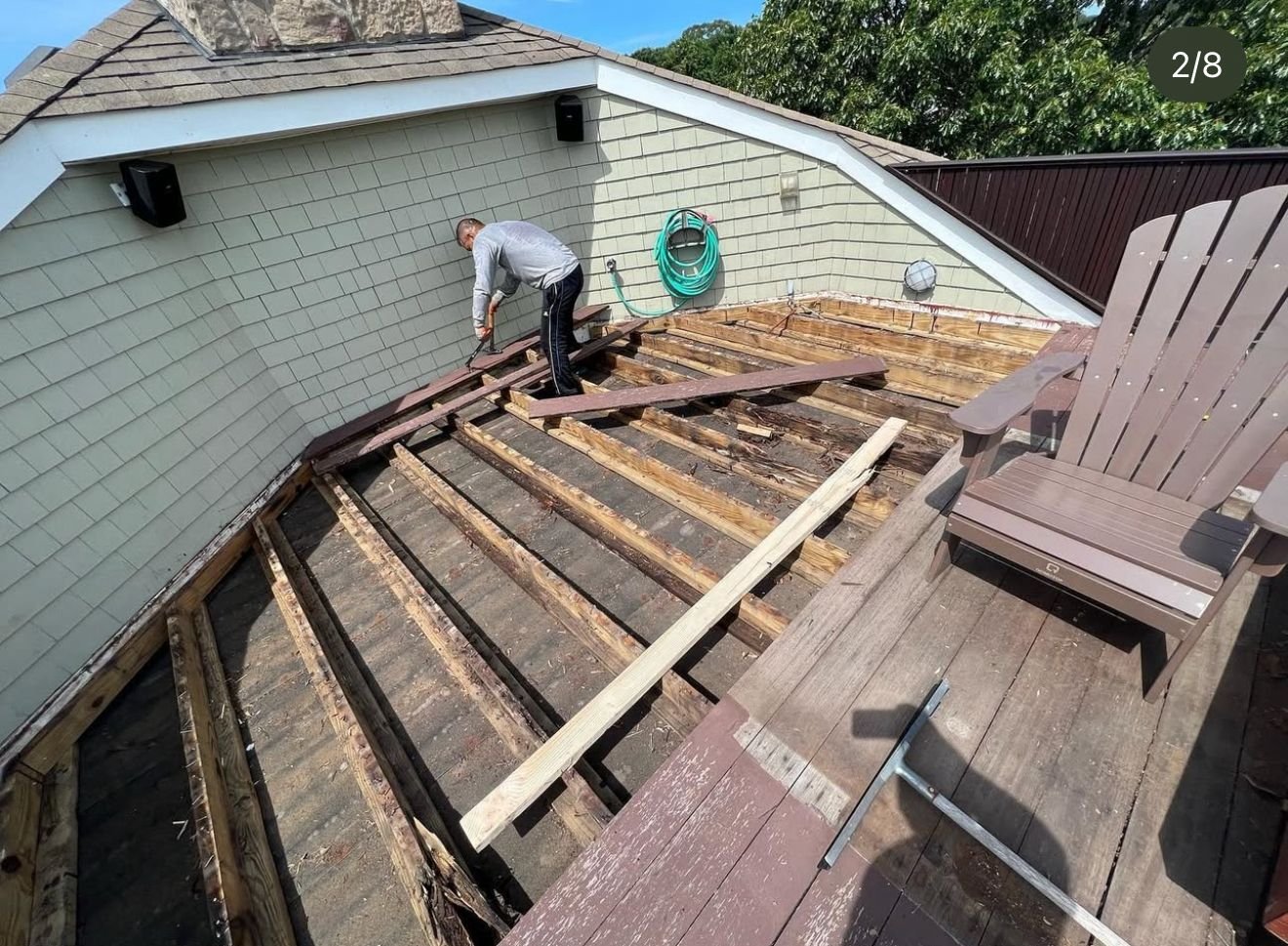

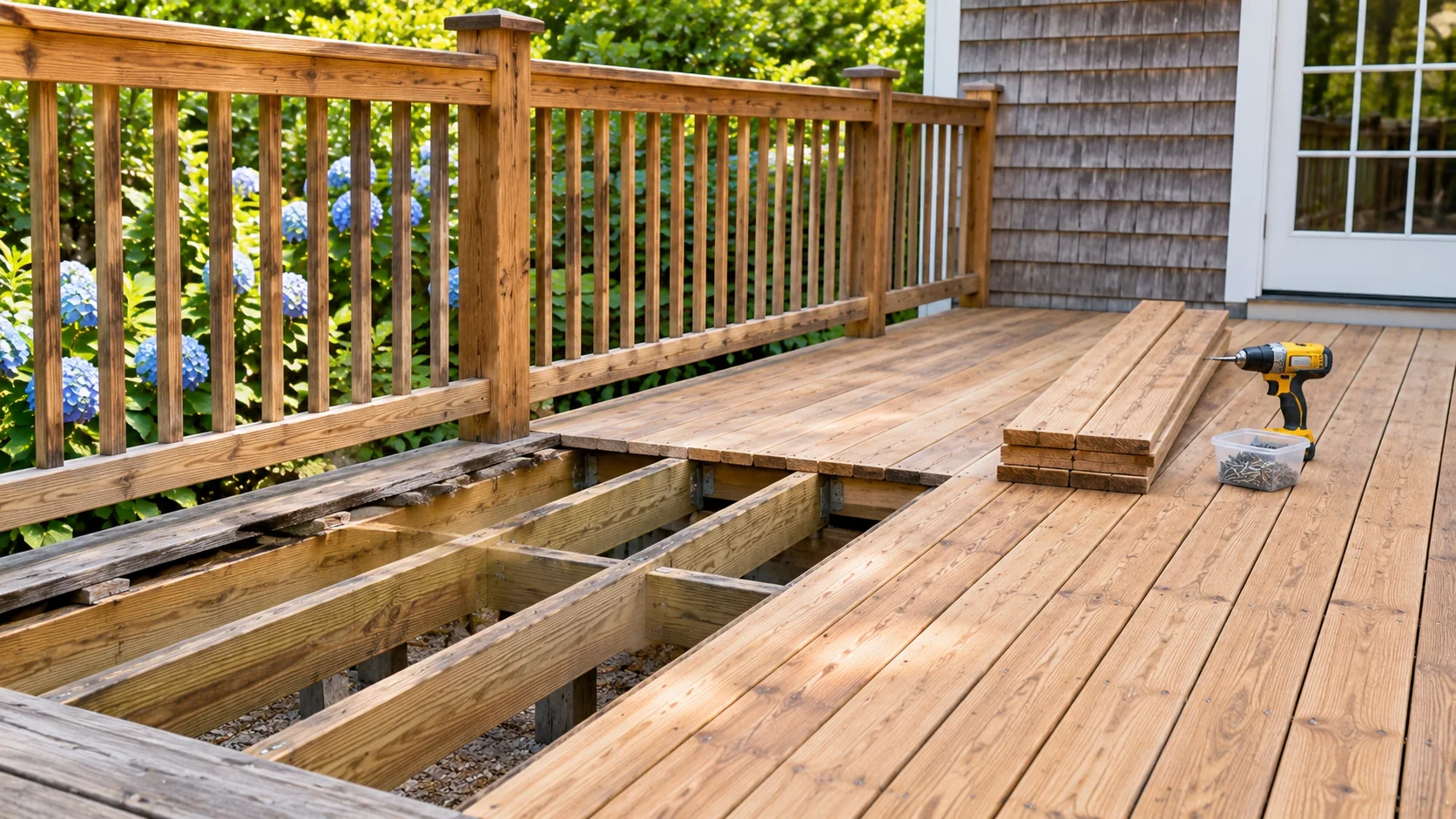
Deck board replacement in Mattituck, NY, can give an aging outdoor space a fresh appearance without necessarily rebuilding the entire deck. If the existing frame is in good condition, homeowners may be able to replace worn decking boards while keeping much of the supporting structure.
However, new boards cannot make an unsafe deck structurally sound.
Before choosing deck resurfacing, it is important to examine the framing, connections, posts, and other structural components beneath the visible surface.
For homeowners in Mattituck and the North Fork of Long Island, this decision can make a significant difference in project scope, material selection, and overall cost.
The goal is not simply to make an older deck look new. It is to determine which parts can safely remain and which need attention.
What Is Deck Board Replacement?
Deck board replacement involves removing existing decking boards and installing new ones.
Unlike a complete deck rebuild, this approach may preserve the original joists, beams, posts, and other supporting components.
It is sometimes called deck resurfacing or redecking.
The terms can vary between contractors, so the written estimate should explain exactly which components will remain and which will be replaced.
For example, an older deck may have weathered boards with extensive splintering while the framing below remains suitable for continued use.
In that situation, replacing the surface could be a reasonable option.
A different deck may have boards that look acceptable while its supporting structure suffers from hidden moisture damage.
That deck may require far more work.
This is why an on-site inspection should come before deciding on a resurfacing project.
Why Mattituck Decks Develop Surface Damage
Outdoor decks in Mattituck are exposed to changing weather throughout the year.
The combination of sunlight, moisture, seasonal temperature changes, and regular use can affect decking materials over time.
Properties near the water may also experience additional exposure to salt and moisture.
However, the rate of deterioration depends on the deck’s materials, installation, drainage, and maintenance history.
Sunlight and Weathering
Wood decking gradually changes appearance when exposed to sunlight.
Some boards develop a gray surface, while others may show cracking, raised grain, or worn coatings.
Discoloration alone does not mean replacement is necessary.
A deck with mainly cosmetic weathering might benefit from appropriate cleaning or refinishing instead.
When boards have significant physical damage, replacement becomes more relevant.
Moisture Around Deck Boards
Leaves, soil, and other debris can collect between decking boards.
If these areas remain damp, moisture may contribute to deterioration.
Water can also affect the framing underneath the surface, especially around exposed connections.
A deck may require more than new boards if moisture has damaged its supporting components.
Repeated Outdoor Use
Decks often support outdoor furniture, planters, dining areas, and everyday foot traffic.
Over time, boards may wear unevenly.
Areas around stairs, entrances, and frequently used pathways can show different levels of deterioration.
The condition of each section should be considered when deciding between limited board replacement and a larger project.
Can You Replace Deck Boards Without Replacing the Frame?
Yes, in some cases.
Deck board replacement without rebuilding the frame may be possible when the existing structure has been inspected and found suitable for the proposed work.
But the decision involves much more than checking whether the joists look straight.
The North American Deck and Railing Association’s deck evaluation guide identifies several important areas for inspection, including supports, beams, joists, ledger connections, decking, stairs, and railings.
These components work together to support the deck.
If any critical part is deteriorated or inadequately connected, new surface boards cannot correct the underlying problem.
The Joists Must Be in Suitable Condition
Joists support the decking boards.
Before reusing them, a qualified professional should evaluate their condition, spacing, span, and connections.
Signs of decay, deep splitting, or other structural problems may require repair or replacement.
The joist spacing must also be suitable for the new decking product.
This becomes particularly important when changing from wood decking to certain composite materials.
The Ledger Connection Needs Attention
For decks attached to a house, the ledger connection is a particularly important part of the structure.
The ledger helps connect the deck to the building.
Improper attachment, deteriorated wood, or moisture damage around this area can create serious safety concerns.
NADRA’s guidance on safer deck construction explains why proper ledger fastening and moisture protection matter.
A new deck surface should never be used to hide concerns involving the ledger or house connection.
Posts, Beams, and Footings Matter
The condition of the supporting posts and beams also affects whether the frame can remain.
A deck may have good-looking joists while its posts, footings, or connections require attention.
Visible settlement, unusual movement, or deterioration around supporting components should be evaluated before resurfacing.
In some cases, structural repairs may allow the project to proceed.
In others, rebuilding may be the more appropriate solution.
Signs Your Deck Boards May Need Replacing
Not every surface problem requires immediate board replacement.
However, several conditions can indicate that new decking may be worth considering.
Deep Cracks and Splintering
Wood decking can develop cracks as it ages.
Minor surface checks are different from deep splits that weaken a board.
Boards with significant cracks, loose sections, or sharp splinters may create problems during normal use.
A professional should determine whether individual boards can be replaced or whether deterioration is widespread.
Soft or Decaying Wood
Wood that has lost its firmness may be deteriorating.
Decay can develop in areas exposed to persistent moisture, including around fasteners and connections.
If a board appears soft or crumbling, avoid using the affected area until its condition has been assessed.
The problem may extend beneath the visible surface.
Loose or Lifting Boards
Fasteners can loosen over time, and boards may shift or lift.
Sometimes a localized repair is possible.
However, repeated loosening may indicate damage to the wood or underlying framing.
Simply adding screws without checking the supporting material may not correct the cause.
Widespread Surface Deterioration
When numerous boards show significant damage, replacing the deck surface may be more practical than performing many individual repairs.
The final decision should account for the condition of the frame and the expected scope of work.
Wood vs. Composite Deck Boards for Mattituck Homes
Homeowners replacing old decking can often choose between new wood boards and compatible composite decking products.
Both options have advantages, but they have different maintenance and installation requirements.
Replacing Old Boards With Wood
Wood decking remains popular because of its natural appearance.
Different wood species offer different colors, grain patterns, and maintenance characteristics.
Cedar is one option homeowners may consider for its traditional appearance.
Wood decking generally needs ongoing care, including cleaning and finish maintenance where appropriate.
The exact maintenance requirements depend on the wood species and finish.
Switching to Composite Decking
Composite decking may appeal to homeowners seeking a different maintenance routine.
Many composite products do not require traditional wood staining.
However, composite decking still needs cleaning and should be installed according to the manufacturer’s instructions.
Not every existing deck frame is automatically suitable for composite boards.
Joist spacing, fastening systems, ventilation, and the product’s structural requirements must be checked.
A contractor should confirm whether the proposed decking system is compatible with the existing frame.
Can Composite Boards Go Over an Old Wood Frame?
Sometimes, but only after the supporting structure has been evaluated.
An existing frame may require changes before composite decking can be installed.
The manufacturer may specify particular framing and fastening requirements.
A project should not move forward simply because new boards can physically fit over old joists.
When Full Deck Replacement Makes More Sense
Resurfacing is not always the best solution.
A complete rebuild or substantial structural replacement may be necessary when the damage extends beyond the decking surface.
The Frame Has Widespread Deterioration
If numerous joists, beams, posts, or connections are damaged, preserving the old structure may not be practical.
A full rebuild may offer a clearer solution than repeatedly repairing deteriorated components.
The Deck Has Structural Movement
Unusual swaying, sinking, or movement can indicate serious problems.
These conditions require professional attention.
Do not continue using an unstable deck while waiting for cosmetic improvements.
The Existing Design No Longer Meets Your Needs
Some homeowners choose to rebuild because they want a larger deck, a new layout, different stairs, or updated railings.
Keeping the original frame may limit those changes.
A new design may be more suitable when the existing structure cannot reasonably accommodate the desired improvements.
The Existing Frame Is Not Suitable for the New Material
Some replacement decking products require framing conditions that the existing structure does not provide.
If substantial modifications would be necessary, a wider replacement project may make more sense.
Golden Hands Deck offers both deck repair and complete replacement services. Visit the Golden Hands Deck website to explore the available options.
How Much Does Deck Board Replacement Cost in Mattituck, NY?
The cost of replacing deck boards depends on the size of the deck, the materials selected, and the condition of the existing structure.
A straightforward resurfacing project may involve fewer structural changes than a complete rebuild.
However, removing old decking can reveal deterioration that was not visible during the initial assessment.
That can affect the final scope and cost.
Other considerations include access to the work area, old material removal, railing modifications, stairs, and the chosen fastening system.
Composite and wood decking products also vary in price.
The best approach is to request a written estimate that explains what is included and identifies any structural repairs that may be necessary.
A lower initial price is not always better if important structural concerns are left unresolved.
What Happens During a Professional Deck Board Replacement?
The process should begin with a review of the existing deck.
A contractor examines visible conditions and determines whether additional inspection is needed before deciding on the work.
Assessing the Existing Structure
The contractor evaluates the decking surface and accessible structural components.
The assessment may reveal damage that changes the recommended scope.
If the frame cannot be safely reused, the project should be reconsidered before new boards are installed.
Removing the Old Decking
When resurfacing is appropriate, the old decking is removed using methods suited to the existing structure.
This can reveal areas that were previously covered.
Any newly discovered deterioration should be addressed before proceeding.
Preparing for the New Material
The remaining frame must be suitable for the selected decking product.
The contractor should consider the manufacturer’s installation instructions, proper connections, and applicable requirements.
Any necessary structural repairs or approved modifications should be completed before the new surface is installed.
Installing the Replacement Boards
New decking is installed using the appropriate fastening system and layout.
The exact method depends on the product and project requirements.
Stairs, railings, and other affected components also need proper attention.
The completed work should be checked before the deck returns to normal use.
Does Deck Resurfacing Require a Permit in Mattituck?
Permit requirements depend on the type and extent of the proposed work and the authority responsible for the property.
Mattituck is within the Town of Southold, but project requirements should be confirmed directly with the appropriate local building department.
Replacing a few surface boards may be treated differently from changing structural framing, railings, stairs, or the deck’s dimensions.
Do not assume that reusing part of the existing deck automatically eliminates permit requirements.
Before starting, confirm whether approvals, inspections, or other documentation are needed for the proposed scope.
How to Make Replacement Deck Boards Last Longer
Choosing suitable materials is only part of maintaining an outdoor deck.
Regular care also matters.
Keep leaves and debris from collecting between boards. Pay attention to drainage, moisture-prone areas, and signs of loose hardware.
Follow the decking manufacturer’s cleaning and maintenance instructions.
For wood decking, maintain suitable protective finishes when needed.
Composite decking requires its own care routine, even when traditional staining is unnecessary.
Periodic deck evaluations help identify possible concerns involving the surface and supporting components.
Most importantly, do not treat new decking boards as proof that the entire structure is sound.
Frequently Asked Questions About Deck Board Replacement
Is it cheaper to replace deck boards than rebuild the entire deck?
It can be, particularly when the existing framing is sound and suitable for reuse. The actual cost depends on materials, labor, structural condition, and the work required.
Can I replace just a few damaged deck boards?
Sometimes. Individual boards may be replaceable when the damage is localized and the supporting structure is suitable.
How do I know if my deck frame is still good?
A qualified professional should examine joists, beams, posts, ledger connections, hardware, and other supporting components. Surface appearance alone cannot establish structural safety.
Can I switch from wood to Trex decking without rebuilding the frame?
Possibly. The existing frame must meet the selected product’s requirements. Joist spacing, support, connections, and other installation details may need modification.
How long does deck board replacement take?
The duration depends on the deck’s size, materials, access, and the condition of the structure. Hidden damage or additional repairs can extend the project.
Should I replace deck railings at the same time?
Not always. Existing railings may be retained if their condition, connections, and design are suitable. Damaged or noncompliant components may need additional work.
Get a Free Deck Board Replacement Estimate in Mattituck, NY
If your deck boards are cracked, worn, splintering, or deteriorating, you may not need to replace the entire structure.
The important first step is finding out whether the existing frame can remain.
Golden Hands Deck provides deck repair, deck replacement, cedar decking, Trex decking, and railing services throughout its Long Island service areas, including Mattituck.
With over 15 years in business, Golden Hands Deck offers licensed and insured services, clear written quotes, material guidance, and careful cleanup.
Whether you are considering new wood boards, composite decking, or a complete deck rebuild, the team can help you review the available options.
Call (631) 655-5616 or request your free deck estimate online to discuss your deck board replacement project in Mattituck, NY.
Share


